


The enterprise landscape across the Restaurants, Cafes, Cloud Kitchens & Multi-Outlet Food Chains domain is experiencing an unprecedented structural transformation. As customer expectations shift toward instantaneous digital engagement, 24/7 transparency, and friction-free service delivery, organizations still clinging to legacy analog operations, disconnected spreadsheets, and manual phone coordination find their profitability and market share severely eroded. Transitioning to a dedicated, custom-engineered digital platform is no longer merely an IT upgrade—it has become the defining operational catalyst for enterprise survival, scalability, and long-term market dominance.
1. Executive Overview & Industry Context
Operating within Restaurants, Cafes, Cloud Kitchens & Multi-Outlet Food Chains requires managing a complex matrix of time-sensitive variables: staffing logistics, inventory allocation, client communications, compliance audits, and multi-channel billing. Historically, local and regional enterprises addressed these challenges by throwing manual labor at structural problems—hiring additional administrative clerks, dispatchers, and bookkeepers to maintain paper ledgers and manual phone registers.
However, manual human processes are inherently linear and error-prone. As transaction volumes expand, administrative overhead balloons exponentially, margins compress, and human error rates soar. When critical records reside in physical folders or fragmented WhatsApp chat histories, business leadership operates blind without real-time performance analytics, unable to pinpoint revenue leaks, staff idle times, or customer churn triggers.
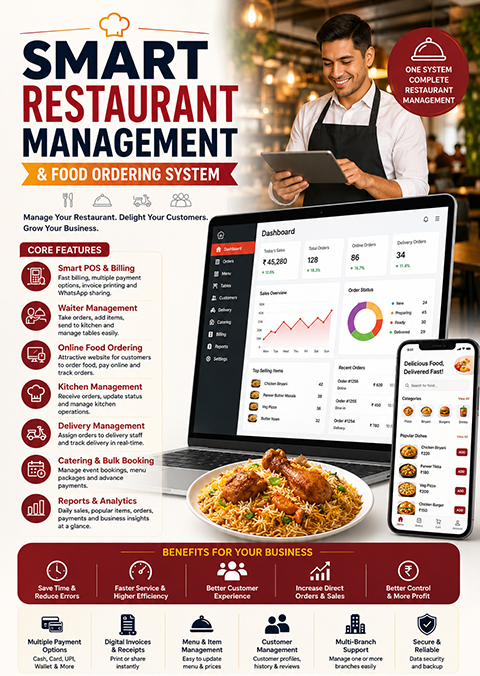
The Smart Restaurant Management & Food Ordering System: Revolutionizing Dining, Kitchen Workflow, and Direct Delivery Operations developed by PrinceNet Technologies completely reimagines this operational paradigm. By centralizing operations onto a cloud-native, mobile-responsive ecosystem, organizations replace guesswork with algorithmic precision, eliminate administrative bottlenecks, and deliver an elevated standard of client satisfaction that commands premium market pricing.
2. The Structural Pitfalls of Legacy & Manual Operations
Before adopting modern digital infrastructure, organizations in Restaurants, Cafes, Cloud Kitchens & Multi-Outlet Food Chains routinely encounter five crippling bottlenecks that restrict growth and damage reputation:
❌ Exorbitant Third-Party Delivery Commissions
Food delivery aggregators siphon between 22% and 32% of total order value, erasing restaurant margins and severing direct customer communication.
❌ Kitchen Communication Lag & Mismatched Orders
Waiters running paper KOTs (Kitchen Order Tickets) across crowded floors leads to lost orders, preparation delays, and high food wastage when kitchen staff misread handwritten notes.
❌ Slow Table Turnaround During Peak Rush Hours
Customers waiting 10 minutes for menus and another 10 minutes to request the physical bill restricts the number of dining parties a restaurant can seat during high-demand lunch and dinner periods.
❌ Uncontrolled Ingredient Pilferage & Stock Wastage
Without dynamic recipe costing and real-time inventory depletion, kitchen managers cannot detect ingredient theft, raw material spoilage, or menu items that operate at a financial loss.
❌ Lack of Customer Retention & Inability to Remarket
Aggregators conceal customer contact details, leaving restaurateurs unable to send loyalty incentives, event announcements, or direct discount campaigns to their own patrons.
These compounded friction points do not merely create daily operational headaches—they translate directly into lost revenue, ballooning overhead, negative public reviews, and high employee turnover as frustrated staff burn out managing avoidable administrative friction.
3. The Digital Transformation Paradigm: Modern Operational Architecture
Implementing PrinceNet's custom-engineered platform replaces fragmented workflows with a cohesive digital nerve center. At its core, the solution operates on a modern micro-service architecture that seamlessly synchronizes administrators, on-field staff, management, and end-consumers into a unified real-time loop.
Instead of waiting hours or days for updates, transactions trigger instant cloud-synchronized actions: bookings automatically dispatch notifications, geofenced mobile apps record biometric attendance, invoices calculate multi-tier taxes and generate payment links, and executive dashboards visualize daily key performance indicators (KPIs). Every interaction leaves an indelible, tamper-proof audit trail, ensuring 100% accountability across the entire organization.
4. Comprehensive Technical Modules & Core Feature Breakdown
PrinceNet's platform integrates state-of-the-art enterprise engineering designed specifically to address the daily complexities of Restaurants, Cafes, Cloud Kitchens & Multi-Outlet Food Chains. Key functional modules include:
⚡ Contactless QR Code Dine-In & Self-Ordering
Diners scan an encrypted table QR code to view interactive digital menus with vivid imagery, dietary filters, and add-on modifiers, placing orders directly into the kitchen without waiting.
⚡ Interactive Kitchen Display System (KDS)
Replaces noisy dot-matrix printers with high-contrast touchscreen displays categorizing incoming orders by prep time, station, and priority, cutting prep delays by over 40%.
⚡ Direct Online Ordering & Fleet Dispatch Portal
Allows restaurants to receive delivery and takeaway orders directly via their website and WhatsApp with zero commission fees, complete with driver dispatch management.
⚡ Real-Time Recipe & Ingredient Inventory Tracking
Automatically deducts raw ingredients (meat, dairy, spices, packaging) based on standardized recipe formulas the moment an order is punched, flagging low stock before items run out.
⚡ Multi-Branch Cloud POS & Centralized Menu Management
Enables restaurant owners to monitor live sales across multiple outlets, update pricing instantly across branches, and analyze best-selling dishes from any smartphone.
5. Operational Improvements, Staff Productivity & Error Elimination
When routine administrative tasks are automated, the nature of human work inside the organization is fundamentally elevated. Coordinators who previously spent 75% of their working hours manually fielding repetitive telephone inquiries, calculating billing line items, and updating paper files are suddenly liberated to focus on high-value business development, customer relationship management, and service quality control.
Furthermore, digital validations make costly arithmetic and human entry mistakes mathematically impossible. Data entered at the point of origin—whether by a customer on a smartphone or an agent at a counter—flows seamlessly into accounting, inventory, and dispatch systems without requiring secondary manual re-entry. This eliminates transcription errors, duplicate records, and costly invoicing disputes.
6. Customer Experience Revolution & Brand Loyalty
Modern consumers and corporate clients do not judge businesses solely on the core product; they evaluate the ease, speed, and transparency of the total experience. In an era where consumers book flights and order groceries in seconds, enduring cumbersome phone calls, delayed quotes, and paper receipts destroys brand equity.
With our digital platform, clients experience frictionless empowerment: instant digital bookings, transparent live tracking, automated WhatsApp updates, and secure one-click digital invoice settlement. This level of modern operational sophistication inspires immense customer trust, generates glowing organic word-of-mouth recommendations, and establishes a durable competitive moat that legacy competitors cannot breach.
7. Quantifiable Financial Impact & Performance Benchmarks
The decision to digitalize is justified not merely by operational elegance, but by rapid, measurable financial return on investment (ROI). Below is a direct operational comparison between traditional manual operations and an enterprise digitized platform engineered by PrinceNet:
| Operational Dimension | Traditional Manual Approach | PrinceNet Digitized Platform |
|---|---|---|
| Average Order-to-Kitchen Delay | 7 to 11 minutes (paper KOT) | Instantaneous (< 5 seconds via KDS) |
| Third-Party Delivery Commissions | 25% to 30% lost on every order | 0% commission on direct branded portal |
| Table Turnover Speed during Rush | 55–70 minutes per party | 35–45 minutes per party (35% faster) |
| Raw Material & Recipe Wastage | 8% to 12% uncontrolled shrinkage | Reduced to under 2.5% with recipe auditing |
| Direct Online Order Reorders | Under 15% through paper flyers | Over 52% through WhatsApp marketing automation |
By eliminating unbilled service leakages, slashing administrative labor hours by 70%, and dramatically boosting repeat customer retention, businesses deploying this platform typically recover their entire implementation investment within four to six months of going live.
8. Strategic Implementation & Deployment Roadmap with PrinceNet
Transitioning to an enterprise digital platform requires a partner with deep software engineering capabilities and nuanced industry understanding. PrinceNet Technologies executes a proven four-stage deployment methodology designed to ensure flawless execution with zero operational downtime:
- Discovery & Workflow Alignment: We conduct detailed operational audits of your existing business processes, pricing logic, client communication touchpoints, and compliance rules to design bespoke system architectures.
- Custom Engineering & UI/UX Tailoring: Our engineering team crafts lightweight, high-performance web and mobile interfaces branded with your corporate identity, ensuring intuitive ergonomics for both staff and clients.
- Data Migration & Hands-On Team Training: We safely import your existing customer lists, inventory catalogs, and past records into the secure cloud, conducting interactive training sessions for management, front-desk staff, and field operators.
- Continuous Optimization & 24/7 SLA Support: Following go-live, our dedicated support team delivers 99.9% uptime guarantees, regular security patches, automated cloud backups, and proactive feature enhancements.
9. Frequently Asked Questions (FAQs) for Decision-Makers
Q: Can waiters still take orders on handheld tablets if diners prefer not to scan QR codes?
A: Yes. The platform provides a sleek Captain/Waiter Mobile POS app allowing staff to take orders table-side with instant transmission to both the KDS and billing counter.
Q: Does the system support thermal billing printers and electronic cash drawers?
A: Yes. It connects seamlessly via Bluetooth, USB, or LAN to standard ESC/POS thermal printers, barcode scanners, and weighing scales for rapid checkout operations.
Q: Can we update menu item availability instantly when an ingredient runs out?
A: Yes. With a single tap on the POS or management app, any dish can be marked 'Out of Stock', immediately disabling it across all digital QR menus and online ordering pages.
Q: How does the delivery dispatch module work for our in-house delivery boys?
A: Delivery drivers receive orders on their dedicated driver mobile app with customer GPS pins, phone links, and digital payment collection tools.
10. Conclusion: Claim Your Market Leadership with PrinceNet
In an era of relentless technological acceleration, the companies that thrive are those that boldly modernize their operational foundations. The Smart Restaurant Management & Food Ordering System: Revolutionizing Dining, Kitchen Workflow, and Direct Delivery Operations represents the definitive gateway to eliminating manual inefficiencies, scaling customer volume, and securing sustainable enterprise profitability.
Ready to Transform Your Business Operations?
Consult with PrinceNet Technologies today to explore a live interactive demonstration tailored to your exact business specifications. Take the first step toward operational automation, cost reduction, and market leadership.
Schedule a Free Strategy Consultation →